
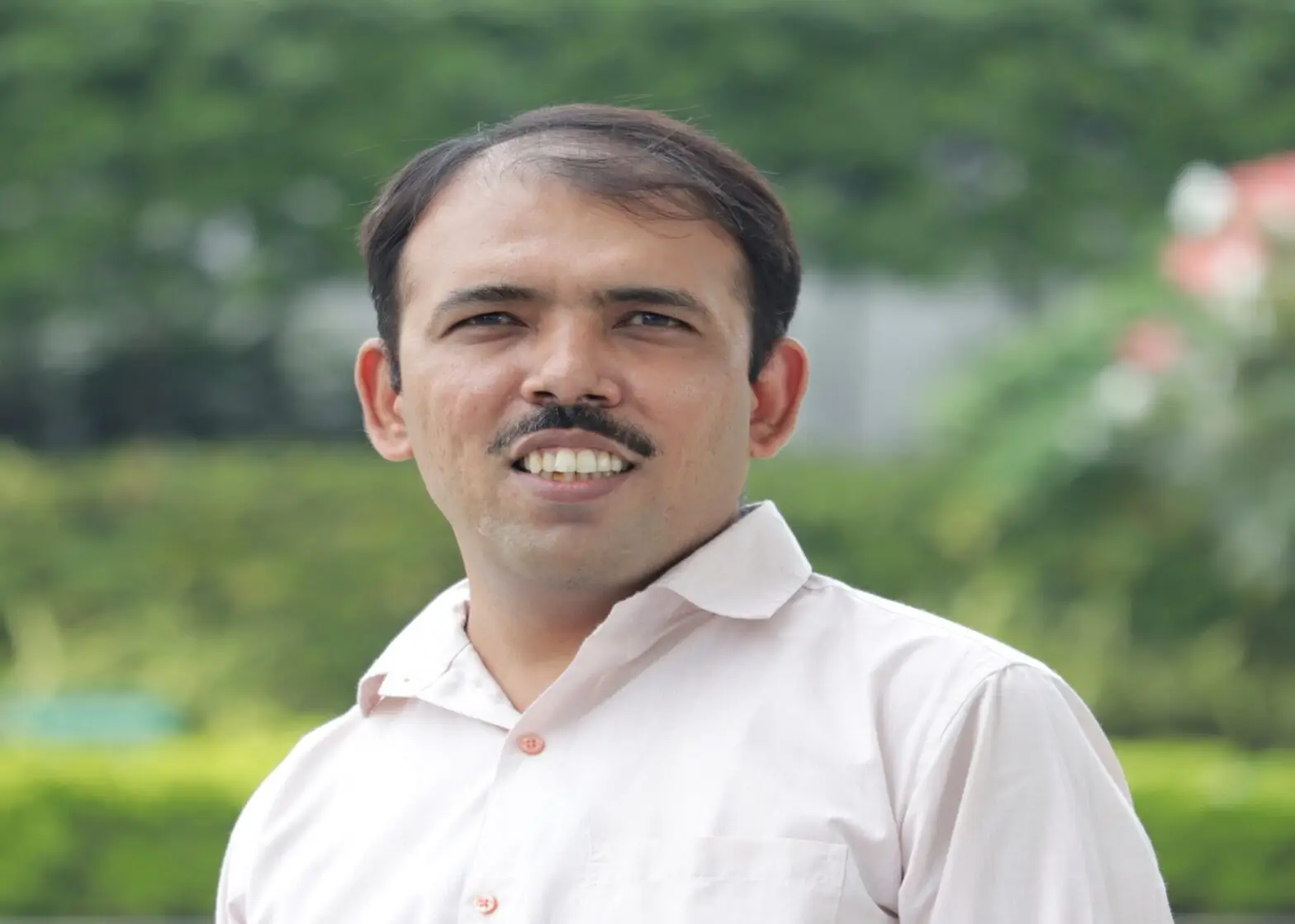
Dr. Imran Pancha, PhD
– Ph.D. in Biological Sciences, 2015
– M.Sc. in Microbiology, 2007
– B.Sc. in Microbiology, 2004
About
I obtained my PhD from CSIR-CSMCRI in 2015, during my doctoral research I mainly worked on biochemical engineering for production of biofuels and industrially relevant products from microalgae. Apart from this I also involved in production of biopolymers and enzymes from extremophilic bacteria. After my PhD, I joined Tokyo institute of Technology-Japan through prestigious JSPS postdoctoral fellowship (2016-2018). During my tenure as JSPS postdoc fellow I mainly worked on TOR signalling in microalgae and its role in sustainable biomass production. After returning from Japan, I joined SRM University-AP in 2019 as Assistant Professor where I mainly involved in undergraduate teaching and supervision of doctoral students.
Background
- Ph.D. in Biological Sciences, 2015 from Central Salt and Marine Chemicals Research Institute (CSIR-CSMCRI), Gujarat.
- M.Sc. in Microbiology, 2007 from Bhavnagar University
- B.Sc. in Microbiology, 2004 from Bhavnagar University
Honours and Awards
- 2018: EMBO travel grant to present work at EMBO workshop on target of rapamycin (TOR) signaling in photosynthetic eukaryotes
- 2016: Recipient of JSPS Post-Doctoral Fellowship (2016-2018) sponsored by Japanese Society for Promotion of Science, Japan
- 2015: Visiting fellowship to University of Campinas (UNICAMP), Sao Paulo, Brazil
- 2012: Recipient of Senior Research Fellowship (2012-2015) sponsored by Council of Scientific and Industrial Research (CSIR), New Delhi
Research Expertise
- Bioprocess engineering, Microalgal Biofuels & biorefinery, TOR signaling in microalgae, Microbial enzymes
Research Group Overview
Our research laboratory is dedicated to understanding and harnessing the biological potential of microalgae, cyanobacteria, and their associated microbial communities for sustainable biotechnological applications. Our multidisciplinary research integrates microbiology, biochemistry, omics, molecular biology, microbial ecology, and bioprocess development.
A major focus of our laboratory is understanding the molecular regulation of carbon reserve accumulation, particularly triacylglycerols (TAGs) and starch in microalgae. We investigate chemical modulators and small molecules that can enhance biomass production and energy-reserve accumulation, with the aim of developing scalable and economically viable microalgal cultivation strategies. We also explore bioactive pigments, including phycobiliproteins and carotenoids, produced by microalgae and cyanobacteria under extreme environmental conditions. Our research examines their antioxidant, anti-aging, and potential therapeutic properties. In addition, we investigate algal–bacterial interactions to discover microorganisms and enzymes capable of efficient biomass degradation. By integrating microbial ecology, enzyme bioprospecting, and bioprocess optimization, our laboratory aims to develop sustainable solutions for biofuels, bioproducts, and value-added applications.
Publications
- Mehta, Khushal, Shubham Rathod, Murali Krishna Paidi, Jayaseelan Murugaiyan, and Imran Pancha. Seaweed extract enhances biomass production and nutrient stress mitigation in freshwater microalga Scenedesmus sp. Bioresource Technology Reports (2026): 102581. IF-5.0.
- Komiya, Sota, Imran Pancha, Hiroki Shima, Kazuhiko Igarashi, Kan Tanaka, and Sousuke Imamura. Target of rapamycin signaling regulates starch degradation via α-glucan water dikinase in a unicellular red alga. Plant Physiology 197, no. 4 (2025): kiaf106. IF- 8.2.
- Imran Pancha, Hiroki Shima, Nahoko Higashitani, Kazuhiko Igarashi, Atsushi Higashitani, Kan Tanaka, and Sousuke Imamura. Target of rapamycin (TOR) signaling modulates starch accumulation via glycogenin phosphorylation status in the unicellular red alga Cyanidioschyzon merolae. The Plant Journal 97(2019):485-499. IF-6.2.
- Imran Pancha, Kaumeel Chokshi, Rahulkumar Maurya, Sourish Bhattacharya, Pooja Bachani, and Sandhya Mishra. Comparative evaluation of chemical and enzymatic saccharification of mixotrophically grown de-oiled microalgal biomass for reducing sugar production. Bioresource Technology 204 (2016): 9-16. IF-8.2.
- Imran Pancha, Kaumeel Chokshi, Basil George, Tonmoy Ghosh, Chetan Paliwal, Rahulkumar Maurya, and Sandhya Mishra. Nitrogen stress triggered biochemical and morphological changes in the microalgae Scenedesmus sp. CCNM 1077. Bioresource Technology 156 (2014): 146-154. IF-8.2.